


Entropy in Art
Updated: Jul 8

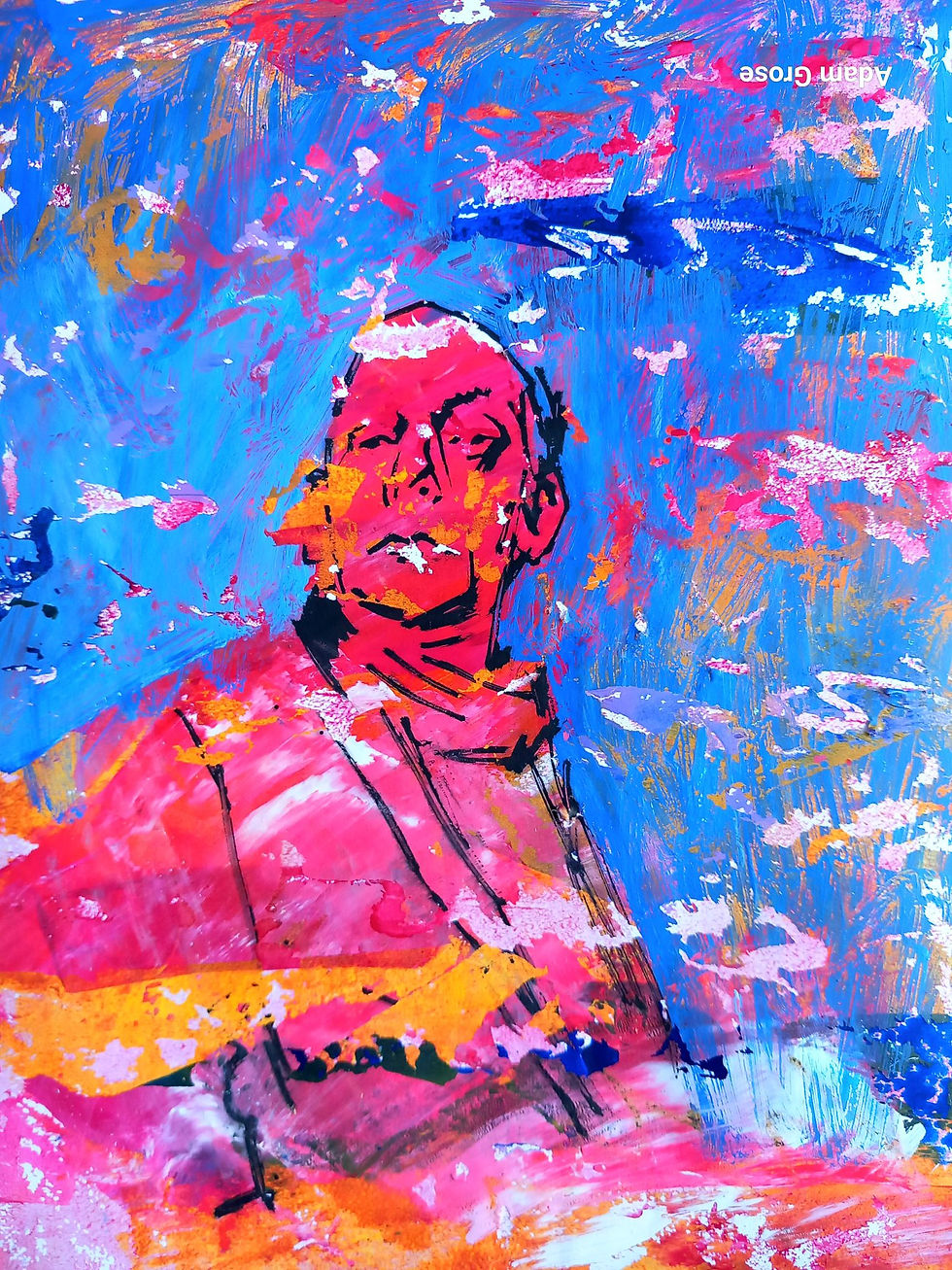
These works I am currently exploring acts as surfaces for historical accumulation, erosion, and material memory. Constructed through layered pigments, acrylics, medium, fractured forms, and disrupted textures, this piece exists between painting, artefact, and ruin.
The tile-like object resembles a recovered fragment - something excavated from an uncertain architectural or cultural form, that carries a trace of both preservation and collapse. These are inspired by many pieces of architecture and found objects I have seen in many museums and galleries around the world, something I have always been fascinated by, ensuring I visit the museums in the countries I visit.
The composition is dominated by dense blue and green fields interrupted by ruptured white forms, resembling cracked plaster or broken ceramics, or maybe even exposed fresco surfaces. These fractured passages feel less painted - revealed, as though the work has undergone a process of deterioration over time. The cracks running through the surface reinforce sensations that the object has endured pressures, weathering, and transformation rather than existing as a static image.

What becomes central in this piece is the tension between permanence and inevitable decay. The work seeks to explore entropy not simply as destruction, but as a fundamental condition of existence. Every layer, gesture, and mark simultaneously builds the image, while also anticipating its collapse. The surface appears caught between emergence and disappearance, echoing the way histories, ideologies, and cultural symbols are continuously constructed, eroded, and rewritten across time. Myth reorganising and reforming into our post-modern mythologies.
The fragmented white forms function archaeologically. Areas of colour seem excavated rather than composed, allowing the work to oscillate between abstraction, landscape, ruin, and relic. Red splattered marks puncture the cooler tones, like traces of memory, violence, or emotional residue embedded within the materials itself.
Underlying the work is an awareness that all objects - including artworks - inevitably succumb to entropy. No matter how carefully humanity attempts to preserve the cultural achievements of the past, time continuously alters and destabilises them. In this sense, the piece questions the traditional desire for permanence in art. Rather than resisting decay, the work embraces deterioration as an essential and truthful process, reminding us of our mortality as a species and as a collective civilisation.
This idea resonates with the work of Gustav Metzger, whose concept of auto-destructive art challenged the assumption that art must survive indefinitely as a fixed cultural object. Metzger approached destruction as both an aesthetic and political condition - reflecting the anxieties of technological modernity, industrial violence, and ecological collapse. Similarly, this work understands ruination not as failure, but as transformation: the image breaks down in order to reveal new meanings and histories beneath its surface, whlist being aware of the destructive tendencies of humanity.
The work can also be understood through the writings of John Berger, particularly his understanding that images are never neutral or timeless, but shaped by shifting historical and social conditions.
'Yet, although every image embodies a way of seeing, our perception or appreciation of an image depends also upon our own way of seeing.'
(Ways of Seeing, Berger John, 1972)
Berger’s notion that meaning changes depending on context and reproduction is echoed in the unstable nature of the surface here. The work resists becoming a singular, fixed image; instead, it behaves like cultural memory itself — fragmented, layered, and continuously reinterpreted. In this piece, abstraction and ruin disrupt conventional ways of reading the image. The fractured surface destabilises distinctions between beauty and damage, preservation and destruction, forcing the viewer into a space of uncertainty where meaning is continually shifting - uncovering buried systems of thought, power, and historical discourse - becoming materially embodied in the layered surface.

The cracks and ruptures become metaphors for the instability of historical narratives themselves, informed by the conditions of a post-industrial culture. The distressed surface evokes the physical remnants of industrial decline: corroded walls, abandoned infrastructures, weathered signage, contaminated urban textures. In post-industrial societies, ruins become monuments to the past and to failed promises of progress and permanence. The work reflects this atmosphere of cultural exhaustion and transformation, where materials and histories persist now only as fragments. Nostalgia will therefore always infect contemporary culture.

The work questions the preservation of the past and how this can itself become restrictive. There is an implicit suggestion that if culture becomes entirely devoted to conserving the historical form, systems, and ideologies, it risks becoming immobilised by the nostalgia it seeks to preserve and therefore restrict or unable cultural and societal evolution.
Entropy therefore becomes necessary - materially, psychologically, politically, and culturally. The natural erosion of images and objects creates the conditions for renewal and reinvention.
In this sense, the work above extends beyond the physical deterioration of materials and begins to address broader social structures. Just as surfaces crack and collapse to reveal new forms beneath them, societies must also allow outdated systems, hierarchies, and outdated modes of thinking to erode, if genuine progress is to occur. The work suggests that moving forward requires space to be made for emerging generations, new voices, and alternative ways of imagining collective life - spaces are made to be filled with new thoughts, new ideas and new modes of thinking.

What deserves preservation, therefore, is not the authority of old structures themselves, but only the elements that remain capable of contributing to the betterment of a contemporary society as a whole, rather than serving the interests of a few, who seek to maintain traditions that serve no purpose other than to preserve a stagnant status quo, in-turn stratificating society.
In this way, this work argues that for an art to continue evolving, it must remain open to multiple forms of creativity, experimentation, and expression, rather than adhering to outdated modes of creation that can limit cultural growth and transformation. Entropy becomes not simply an ending, but a necessary process of transitioning - a clearing away to allow transformation, growth, and future emergents.
Rather than mourning loss romantically, the work accepts impermanence as inseparable from life itself. The damaged surface becomes evidence of time, vulnerability, and continual change, never coming back together exactly again, forever changed. In this way, the artwork does not attempt to escape entropy; instead, it embodies it, allowing decay to become part of the work’s meaning, structure, and vitality, in-turn revealing the importance of the 'present moment' and to enjoy each and every minute that passes, without unnecessarily holding onto a past that exists only as a moment in time and a memory.


Comments